

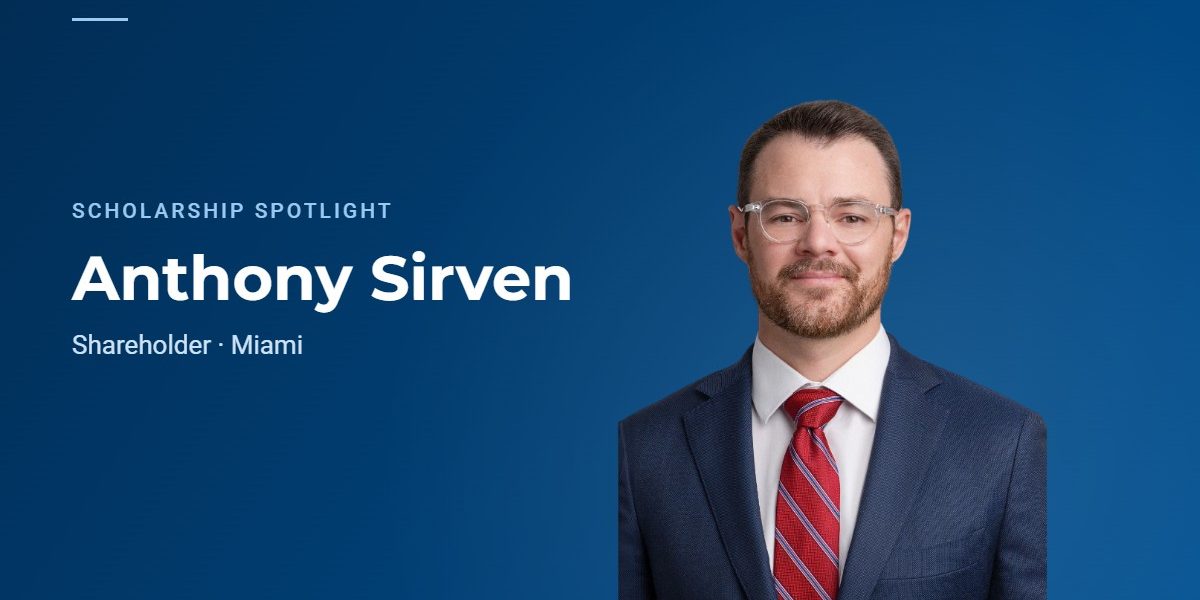
Alongside a commercial trial and appellate practice, Anthony Sirven has spent a decade writing about one constitutional question: what, in the eyes of the law, is the status afforded to unborn human life?

Anthony Sirven’s scholarship began with a student note in the Florida Law Review, where he served as Notes and Comments Editor, and has continued through the Harvard Journal of Law & Public Policy, the Texas Review of Law & Politics, and essays for First Things and Public Discourse. The pieces share a single thread. American courts routinely enforce in-vitro-fertilization and surrogacy contracts by treating embryos as property that the parties jointly own. Anthony’s work asks what follows from that classification, and argues that the law cannot hold the position it has taken.
The 2016 note, “Undue Process: A Father’s Proprietary Interest in an Embryo and Its Clash with Casey,” set out the tension between the family-law decisions recognizing property interests in embryos and the abortion decisions that forbade any paternal consent or notice requirement. The 2024 sequel in the Harvard Journal’s Per Curiam series, “Undue Process: Revisited,” returns to the question after Dobbs and surveys more recent decisions from Colorado, Texas, and Ohio that have reinforced the embryo-as-property framework, in some cases extending contractual enforcement past birth in surrogacy disputes. His conclusion is that there is no stable middle ground: embryos are either persons or property, and a co-owner’s due-process claim exposes the contradiction either way. A 2025 essay in the Texas Review of Law & Politics, “No Property in Man: A Fading Principle,” extends the argument to the concept of constitutional personhood itself, and two shorter essays — for First Things in October 2024 and Public Discourse in March 2025 — bring the same analysis to a general audience.
These are hard questions, and Anthony has followed them with care for ten years, in venues that subject arguments to serious editorial scrutiny. The firm is proud to count that scholarship among its attorneys’ work. It reflects the same discipline he brings to a commercial docket that has included a nine-figure jury verdict and the dismissal, affirmed on appeal, of a multibillion-dollar intellectual-property claim.
Read: Undue Process: Revisited — Harvard Journal of Law & Public Policy, Per Curiam, July 3, 2024
Read: Undue Process: A Father’s Proprietary Interest in an Embryo and Its Clash with Casey — 68 Fla. L. Rev. 1469 (2016)
Read: No Property in Man: A Fading Principle — Texas Review of Law & Politics (2025), via SSRN
Essays: Will Courts Recognize the Personhood of Embryos? — First Things, October 22, 2024 · Property Rights in Children?, Public Discourse, March 25, 2025
About Anthony Sirven
Anthony Sirven is a shareholder in the firm’s Miami office, where he focuses on commercial cases involving fraud, breach of contract, partnership, intellectual property, and M&A disputes at the trial and appellate levels, and he litigates and publishes on constitutional matters. Before joining the firm he was a partner at an Am Law 25 firm and served as a law clerk to Judge Paul C. Huck of the U.S. District Court for the Southern District of Florida. He earned his J.D., magna cum laude, from the University of Florida Levin College of Law.
Publication spotlights summarize work our attorneys have published elsewhere; the views expressed in the original pieces are the authors’ own. Insights posts are offered for general information and are not legal advice.